Kaggle: Monet GAN
Context: I’m Something of a Painter Myself
This Kaggle competition is a style transfer problem: you’re given a set of real-world photos and a set of Claude Monet paintings, and the goal is to generate images that look like Monet paintings.
A key detail is that the datasets are unpaired: there is no “same scene” photo ↔ Monet ground-truth pair. That makes common supervised losses (like pixel-wise MSE against a target image) a bad fit, and it’s why CycleGAN became a standard approach.
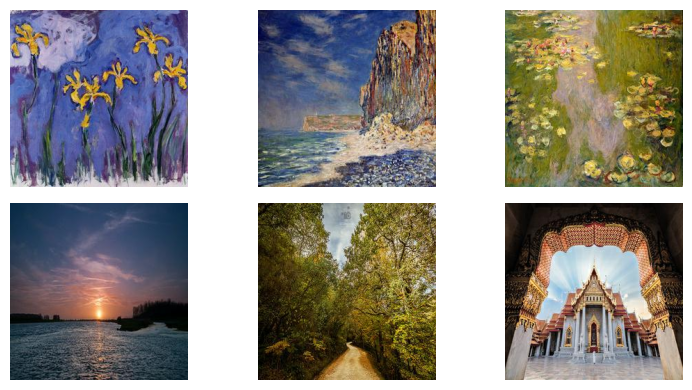
These are some of the original monet images:
What are GANs?
A Generative Adversarial Network (GAN) trains two neural networks in opposition:
- Generator : creates fake samples (images).
- Discriminator : predicts whether an image is real (from the dataset) or fake (from ).
Generator, discriminator, and the core objective
In the original GAN formulation, the discriminator tries to maximize the probability of classifying real and fake images correctly, while the generator tries to fool it:
In practice, many implementations use the “non-saturating” generator loss because it gives stronger gradients early in training:
What are GANs usually used for?
GANs have been used for:
- Image synthesis (creating new images from a learned distribution)
- Image-to-image translation (e.g., photo painting)
- Super-resolution and inpainting
- Domain adaptation (aligning distributions across domains)
For this competition, the relevant category is unpaired image-to-image translation.
GANs used in this project: DCGAN and CycleGAN
Why these two?
They represent two different ways to approach the problem:
- DCGAN learns what Monet paintings look like (unconditional generation), but it does not inherently preserve the content of a specific input photo.
- CycleGAN learns a mapping from photos to Monet style while enforcing content preservation through cycle consistency.
DCGAN
DCGAN (Deep Convolutional GAN) is a classic convolutional GAN where:
- upsamples from a latent vector to an image.
- downsamples an image to output a real/fake score.
Output from DCGAN:
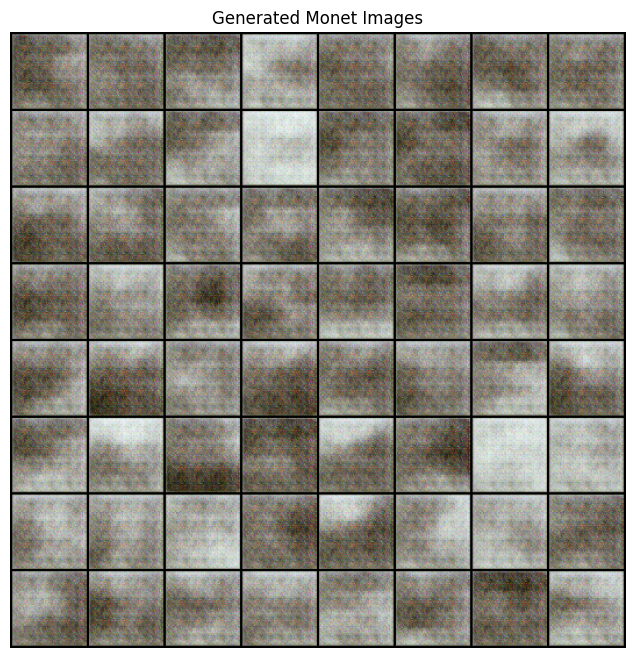
Why did DCGAN give blurry images?
In this competition setting, blurriness (or “soft”, low-detail outputs) is common for a few reasons:
-
No conditioning on the input photo
DCGAN isn’t built to translate this photo into Monet style. It’s built to generate “a Monet-like image”. Without an explicit constraint to preserve structure, it may produce plausible colors/textures but weak scene geometry. -
Training instability
GAN training is a minimax game. If becomes too strong (or training becomes imbalanced), gradients can become unhelpful for , and outputs often get stuck in low-detail regimes. -
Architecture and resolution limitations
If capacity is limited or the receptive field isn’t effective for capturing both global composition and fine brush-stroke texture, the generator learns low-frequency color statistics first, and sharp details may never emerge.
CycleGAN
CycleGAN is designed for unpaired translation.
It learns two mappings:
- (Photo Monet)
- (Monet Photo)
And uses two discriminators:
- distinguishes real Monet images from
- distinguishes real photos from
Cycle consistency (the key improvement)
Since we don’t have paired examples, CycleGAN introduces the idea that translating there-and-back should recover the original:
This is typically implemented as an L1 cycle-consistency loss:
Some implementations also add an identity loss to reduce unnecessary color shifts:
Output from CycleGAN:
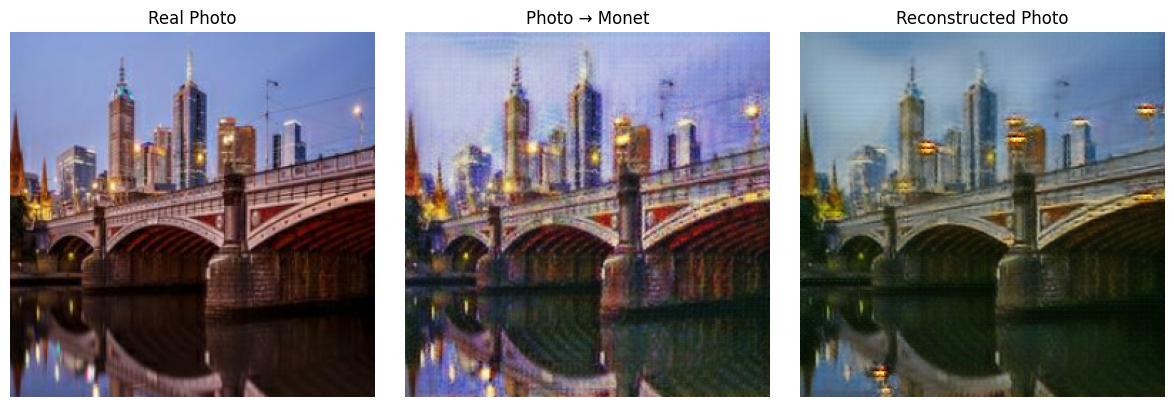
- Real Photo: (input, real)
- Photo → Monet: (generated translation you care about)
- Reconstructed Photo: (generated for training/validation of content preservation)
Why is CycleGAN much better than DCGAN here?
CycleGAN is better for this competition because it enforces both:
- Style realism via adversarial losses (outputs look like Monet paintings)
- Content preservation via cycle consistency (the scene stays recognizable)
So instead of producing generic Monet-like images, it produces Monet-styled versions of your photos.
Why are GANs not as relevant in industry anymore?
GANs still show up in some production systems, but they are no longer the default choice for many image generation problems. A few reasons:
-
Diffusion models dominate modern image generation
Diffusion models are generally more stable to train, scale well, and produce high-quality results across many tasks (generation, editing, inpainting). -
Stability and reproducibility
GANs can be sensitive to hyperparameters and training balance, with failure modes like mode collapse. Many industry teams prefer methods that are easier to train and debug. -
Better control and conditioning elsewhere
Modern workflows often require controllable generation (text prompts, editing constraints, guidance). Diffusion + guidance techniques provide strong control knobs. -
Ecosystem momentum
Tooling, pretrained models, and research attention have largely shifted toward diffusion and transformer-based approaches.
GANs still matter historically (and conceptually), and adversarial losses are still used in some pipelines, but for “state-of-the-art generative imaging” the center of gravity has moved.
Closing thoughts
This competition is a great example of matching the model to the data:
- With unpaired domains, CycleGAN is a natural fit because it learns a mapping and enforces content preservation.
- DCGAN can learn “Monet-ness”, but it is not designed to translate a specific photo, which often shows up as blurry or incoherent outputs in this task.